The Palm Weevil and the killer butterfly
Rhynchophorus ferrugineus and Paysandisia archon in Portugal
In Portugal we have two insects killing Canary Island palm trees (Phoenix canariensis), both the weevil Rhynchophorus ferrugineus and the butterfly, Paysandisia archon. They work together: the weevil is an ally of the butterfly. The adult weevil is a sort of armoured tank whose larvae pierce the crown of the palm or new shoots, and the holes are used by the butterfly who is then able to penetrate the base of the palm fronds. It is not uncommon to see palms attacked by several generations of insects and the larvae of both the weevil and the butterfly. Global research is ongoing to try and find a way to destroy the two killers.
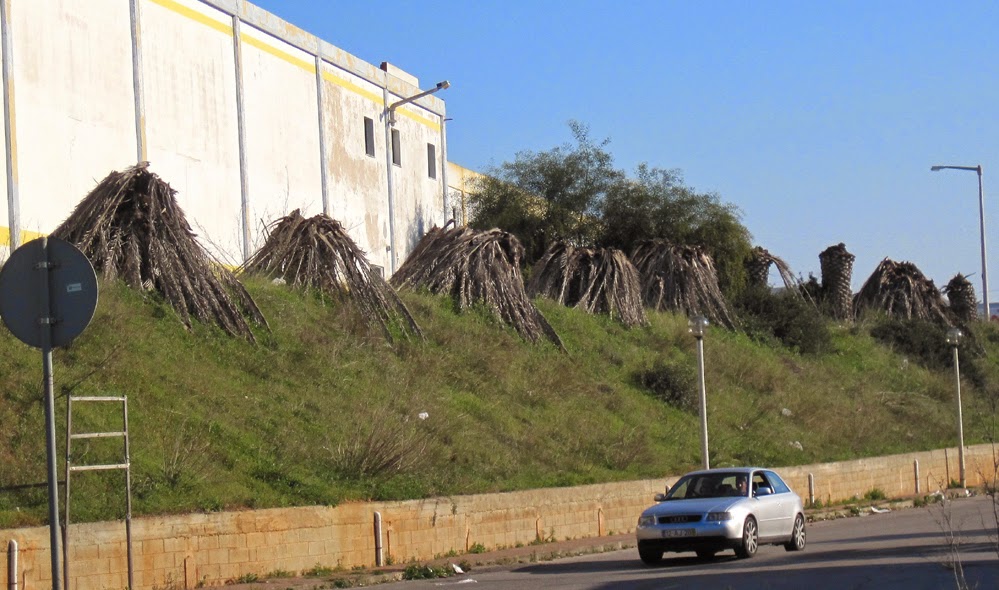 |
| A sad sight on the Algarve, a row of dead Phoenix canariensis. |
As with the Mediterranean fruit fly, a lack of coordinated action at an overall level on the peninsula means that the recommendations of the Ministry of Agriculture may delay the end of the war but will not win it. We must learn to live with it. Prevention is essential, since the enemy is discreet and almost always deadly.
Preventive measures
These measures are essential to prevention.
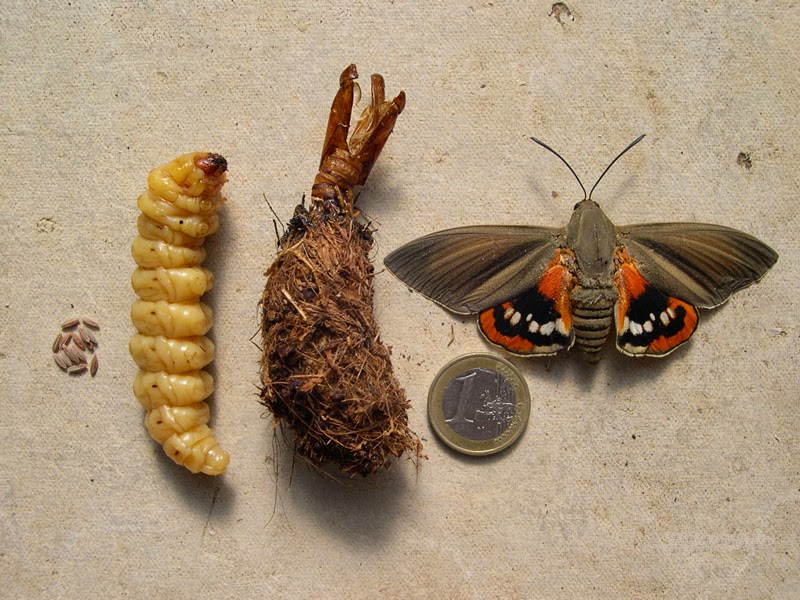 |
| Paysandisia life cycle |
Ask for confirmation from a specialist if available, because other larvae like the Cetonia aurataor or common rose chafer may be confused with the killers. Treat with a systemic insecticide, for example, water the crown with “Confidor” every 30 days in the late summer. You must act quickly, so don’t wait to check your adult palm trees with binoculars. You are looking for sawdust at the foot of the tree. Be sure to remove flowers and fruit before treating as systemic insecticides kill bees, and bees adore Phoenix flowers. It’s one good reason not to generalize the use of systemic insecticides.
It is prudent however to use systemic insecticide after removal of flowers and fruit if there is a palm showing visible signs of attack in the neighborhood. The larvae can take up to two years to kill a palm tree, and generations of larvae develop into adults two to four times per year.
The number of adult insects that will hatch and survive to attack other palms is between 25 and 100 per generation.
Nematodes are deemed to be an effective organic insecticide, but they are very expensive and must be implemented by a qualified professional, who are hard to find. The November 2011 issue of Phytoma, the digital magazine devoted to plant health, indicates that their effectiveness is decreasing while research on insect eating fungus seems promising.
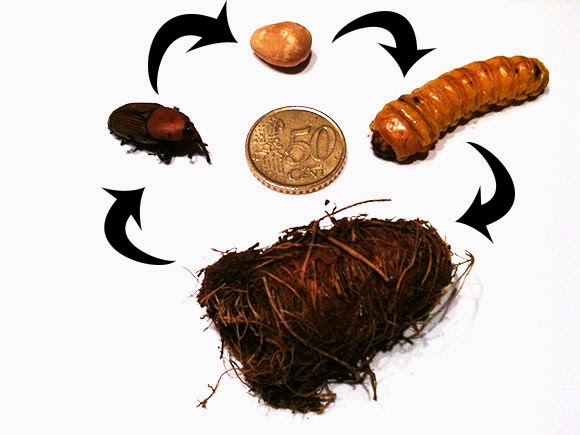 |
| Rhynchophorus life cycle |
Preventive organic treatments (nematodes, bacillus thuringiensis, Beauveria bassiana) are not really economically viable, and the nematodes tend to pollute swimming pools. Egypt and Saudi Arabia have published research on preventive or curative treatments with
plant extracts. The latest publication concerns jojoba oil. They have tested many species of plant-based insecticides.
For the moment we haven’t found any plant-based treatments that are inexpensive enough, as they have to be applied often and
for the lifespan of the palm tree.
The least expensive is Biopalm, which is a latex spray that creates a protective film and only needs to be applied once a year. Though it has proven very effective against the butterfly its effectiveness has not yet been demonstrated against the weevil.
Traps don’t seem to work. There are no known repellents that work. In summary, most preventive techniques currently available require implementation that in many cases is extremely difficult.
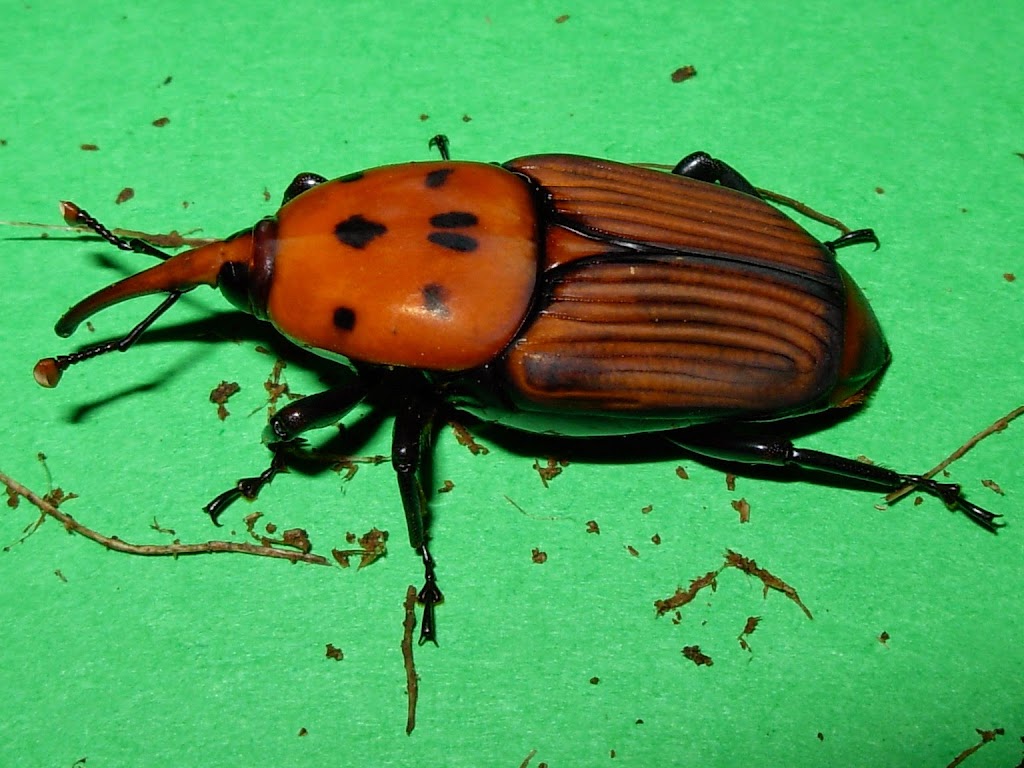 |
| Rhynchophorus ferrugineus – this is the female |
Precautionary measures
According to Javier Segura of Palmasur, no palm trees are safe. However, there are palm trees that are at a higher risk from both killer insects. We have inadvertently helped to spread the killers by the globalization of the trade in palm trees but also by planting Phoenix canariensis in excess. The least we can do is stop attracting the enemy.
Posted by J. P. Brigand
November 2014